As organizations invest more in data-driven strategies, the number of tools used to manage data continues to grow. Terms like CDP, CRM, DMP, and Data Warehouse are often mentioned together — yet they serve very different purposes.
Understanding the difference between these systems is essential. Without clarity, businesses risk building fragmented architectures, duplicating efforts, or making decisions based on incomplete data.
This article breaks down each platform, explains how they differ, and shows how they work together in a modern digital ecosystem.
Why This Comparison Matters
At first glance, these systems may seem similar because they all deal with “data.” However, the key difference lies in how the data is structured, who uses it, and what it is used for.
Choosing the wrong tool — or using the right tool in the wrong way — can lead to:
- Disconnected customer insights
- Inefficient marketing execution
- Poor data governance
- Limited scalability
A clear understanding ensures that each system plays the right role.
1. CRM (Customer Relationship Management)
A CRM system is designed to manage known customer relationships. It stores identifiable information such as names, contact details, purchase history, and sales interactions.
Key characteristics:
- Focus on identified users (known customers)
- Primarily used by sales, marketing, and support teams
- Stores structured, transactional, and relationship data
- Often manually updated or system-integrated
Primary use cases:
- Sales pipeline management
- Customer support tracking
- Email marketing and lifecycle communication
👉 In simple terms: CRM is about managing relationships you already know.
2. DMP (Data Management Platform)
A DMP is designed for anonymous audience data, typically used in advertising.
It collects and processes:
- Third-party data
- Cookie-based behavioral data
- Audience segments for ad targeting
Key characteristics:
- Focus on anonymous users
- Short data retention (often 30–90 days)
- Strong integration with ad platforms
- Built for media buying and targeting
Primary use cases:
- Audience segmentation for ads
- Lookalike modeling
- Programmatic advertising
👉 In simple terms: DMP is about reaching new audiences through advertising.
3. CDP (Customer Data Platform)
A CDP unifies customer data from multiple sources into a single, persistent customer profile.
It combines:
- Behavioral data (web/app activity)
- Transactional data (purchases)
- CRM data (customer attributes)
- Engagement data (campaign interactions)
Key characteristics:
- Focus on both known and anonymous users
- Creates a 360-degree customer view
- Enables real-time or near real-time activation
- Used across marketing, product, and analytics teams
Primary use cases:
- Personalization across channels
- Customer journey tracking
- Data activation (email, push, ads, etc.)
👉 In simple terms: CDP connects all your customer data into one unified system.
4. Data Warehouse
A Data Warehouse is designed to store large volumes of structured data for analysis and reporting.
It aggregates data from multiple systems, including CRM, CDP, and other sources.
Key characteristics:
- Focus on historical and structured data
- Used by data teams, analysts, and BI tools
- Optimized for querying and reporting
- Not built for real-time activation
Primary use cases:
- Business intelligence (BI) reporting
- Data analysis and dashboards
- Long-term data storage
👉 In simple terms: Data Warehouse is where data is stored and analyzed at scale.
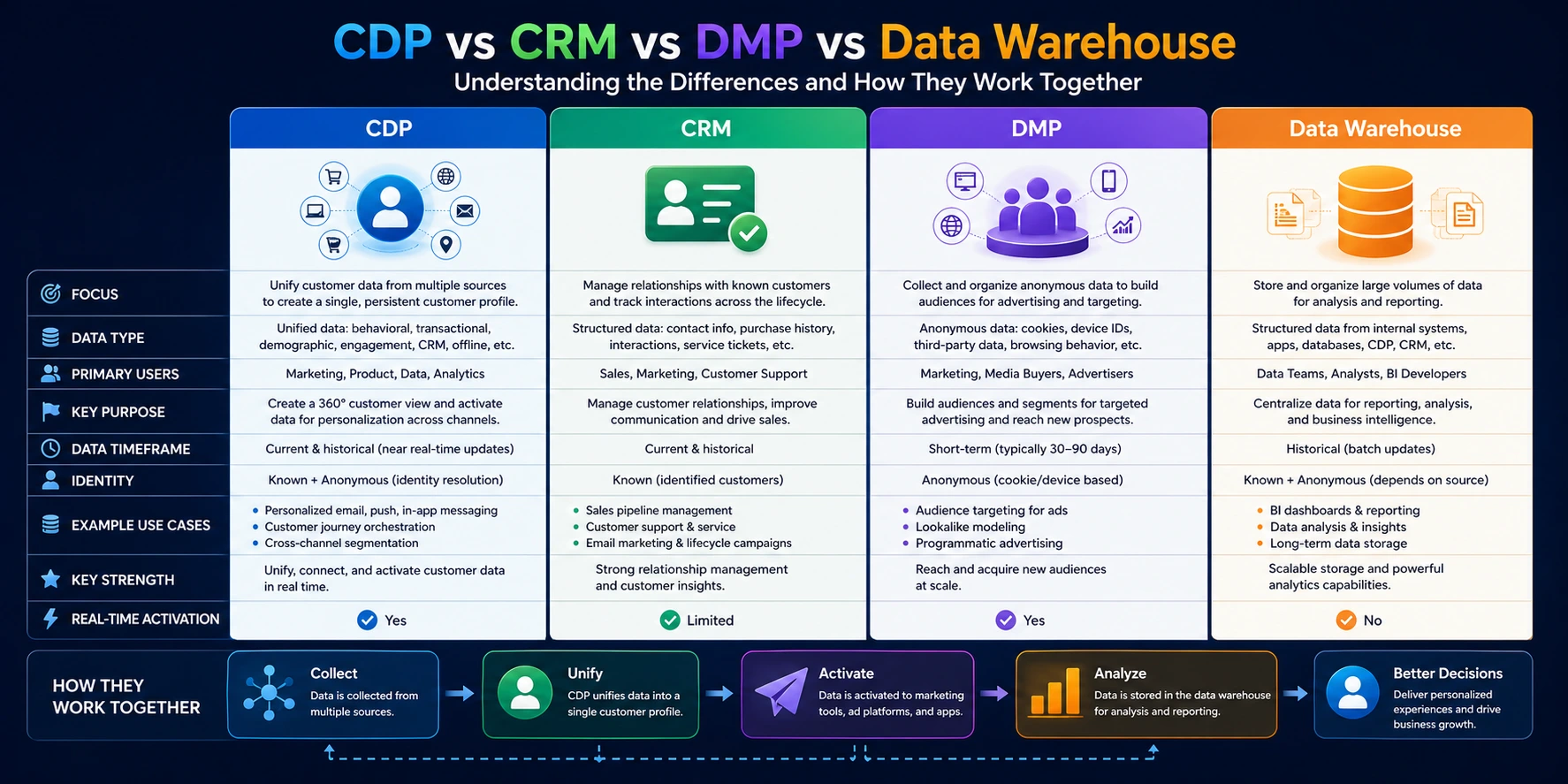
Key Differences at a Glance
| Platform | Data Type | Users | Purpose | Real-Time Use |
|---|---|---|---|---|
| CRM | Known customer data | Sales, Marketing | Manage relationships | Limited |
| DMP | Anonymous data | Marketing (Ads) | Audience targeting | Yes |
| CDP | Unified data | Marketing, Product | Personalization & activation | Yes |
| Data Warehouse | Structured data | Data/BI teams | Analysis & reporting | No |
How These Systems Work Together
Rather than replacing each other, these platforms are most powerful when used together:
- CRM manages direct customer relationships
- DMP supports acquisition through advertising
- CDP unifies and activates customer data
- Data Warehouse stores and analyzes data at scale
When integrated properly, they create a complete data ecosystem:
- Data flows from collection → unification → activation → analysis
- Teams share consistent and reliable information
- Decisions are based on a single source of truth
Building the Right Data Architecture
The goal is not to choose one tool over another — but to design a system where each tool plays the right role.
In 2026, leading organizations focus on:
- Data integration and consistency
- Real-time data activation
- Scalable analytics infrastructure
- Clear ownership across teams
At Zenitrix Core, we help organizations design and implement data architectures that align CDP, CRM, DMP, and Data Warehouse into a unified strategy. From tracking and data collection to analytics and activation, we ensure your data ecosystem is structured, reliable, and ready for growth.
Conclusion: From Tools to Strategy
Understanding the difference between CDP, CRM, DMP, and Data Warehouse is the first step. The real value comes from how these systems are connected and used together.
Because in a truly data-driven organization, tools do not operate in silos — they work as a coordinated system that turns data into insight, and insight into action.