In today’s digital landscape, data is one of the most valuable assets a business can have. Yet, many organizations still struggle to answer a simple question: Who are our customers, really?
Data exists across websites, mobile apps, CRM systems, marketing platforms, and more — but without proper structure, it remains fragmented and difficult to use. This is where the concept of a Customer Data Platform (CDP) becomes essential.
What Does CDP Really Mean?
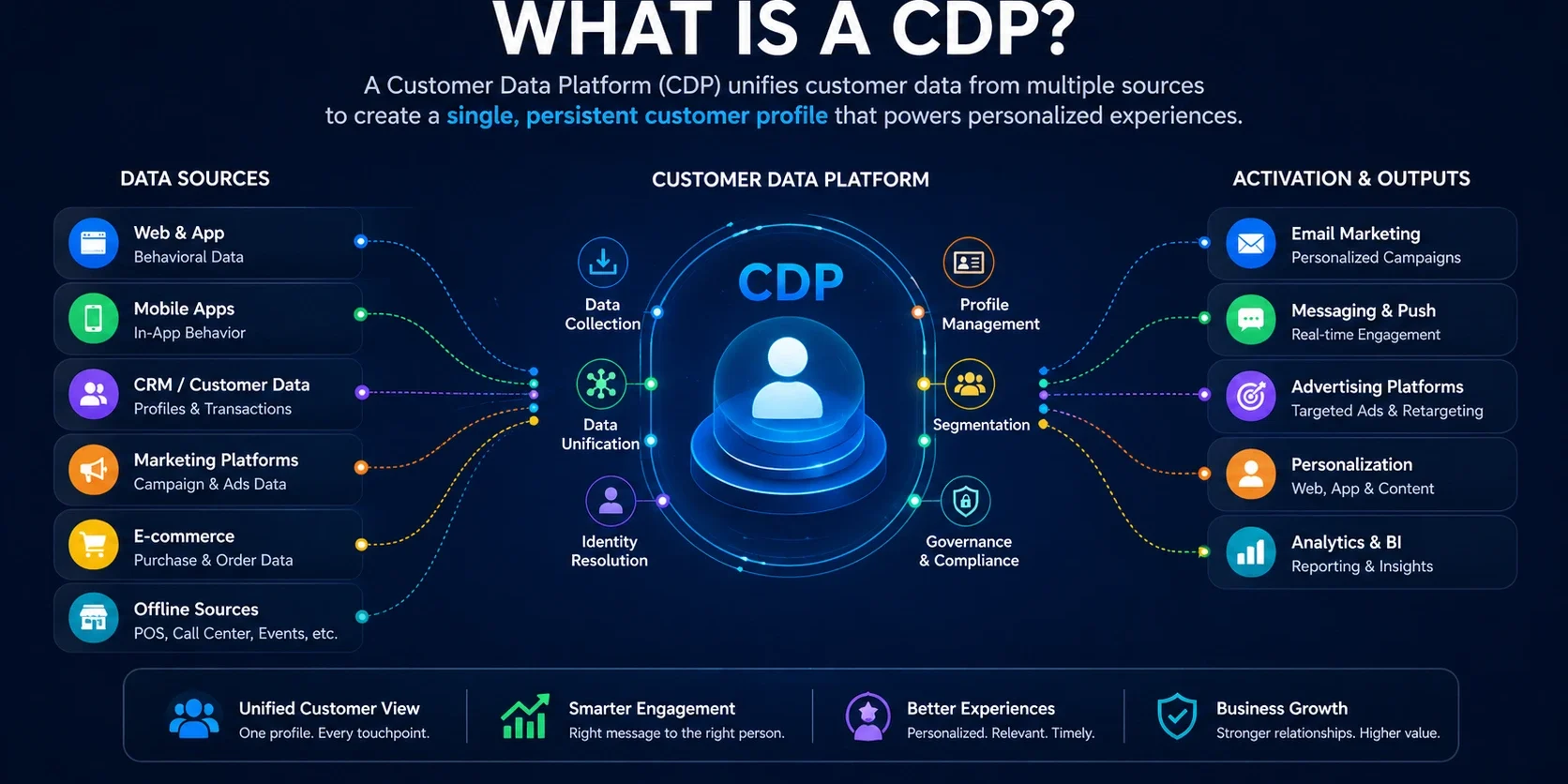
A Customer Data Platform (CDP) is a system designed to collect, unify, and manage customer data from multiple sources into a single, consistent profile.
Unlike traditional tools that operate in silos, a CDP brings together:
- Behavioral data (e.g., website and app interactions)
- Transactional data (e.g., purchases, subscriptions)
- Customer data (e.g., CRM profiles, user attributes)
- Engagement data (e.g., campaigns, messaging interactions)
The result is a unified customer view — often referred to as a 360-degree customer profile — that can be used across marketing, analytics, and engagement systems.
Why CDP Is Different from Other Data Tools
Many organizations already use tools like analytics platforms, CRM systems, or data warehouses. While these tools are powerful, they are designed for different purposes.
A CDP stands out because it is built to:
- Unify data across systems rather than store it in isolation
- Standardize and structure data for consistent usage
- Enable activation across multiple channels
- Support both technical and business teams
In simple terms, a CDP is not just about storing data — it is about making data usable and actionable across the organization.
How a CDP Works in Practice
A CDP typically operates in three core stages:
1. Data Collection
It gathers data from multiple sources such as websites, mobile apps, CRM systems, and third-party tools.
2. Data Unification
It cleans, structures, and connects data points into a single customer profile, often resolving identities across devices and platforms.
3. Data Activation
It sends enriched customer data to marketing tools, personalization engines, and analytics platforms for real-time or near real-time use.
This process transforms raw data into a system that supports both insight and execution.
The Value of Understanding CDP
Understanding the meaning of CDP is not just about definitions — it is about recognizing its role in modern digital strategy.
A well-implemented CDP helps organizations:
- Gain a complete view of their customers
- Improve personalization across channels
- Ensure data consistency and reliability
- Enable faster, data-driven decision-making
Without a CDP (or an equivalent data unification approach), businesses often struggle with fragmented insights and limited scalability.
CDP as the Foundation of Data-Driven Experience
In 2026 and beyond, customer expectations continue to evolve. Users expect seamless, personalized, and consistent experiences across every touchpoint.
A CDP provides the foundation to meet these expectations by connecting data, technology, and experience into a unified system.
At Zenitrix Core, we view CDP not just as a tool, but as a core component of a data-driven digital experience strategy. By aligning data collection, analytics, and activation, we help organizations turn customer data into meaningful, measurable outcomes.
From Definition to Strategy
Understanding what a CDP is marks the beginning of a broader journey — one that connects data to insight, and insight to action.
Because when customer data is unified, structured, and actionable, businesses can move beyond assumptions and start building experiences that truly matter.