In today’s digital ecosystem, businesses are collecting more customer data than ever before — from websites, mobile apps, CRM systems, advertising platforms, and beyond. Yet despite this abundance of data, many organizations still struggle to understand their customers clearly or act on insights effectively.
The challenge is not a lack of data. It is the lack of a unified, reliable, and actionable customer view. This is where a Customer Data Platform (CDP) becomes essential.
The Problem: Fragmented Data Across Multiple Systems
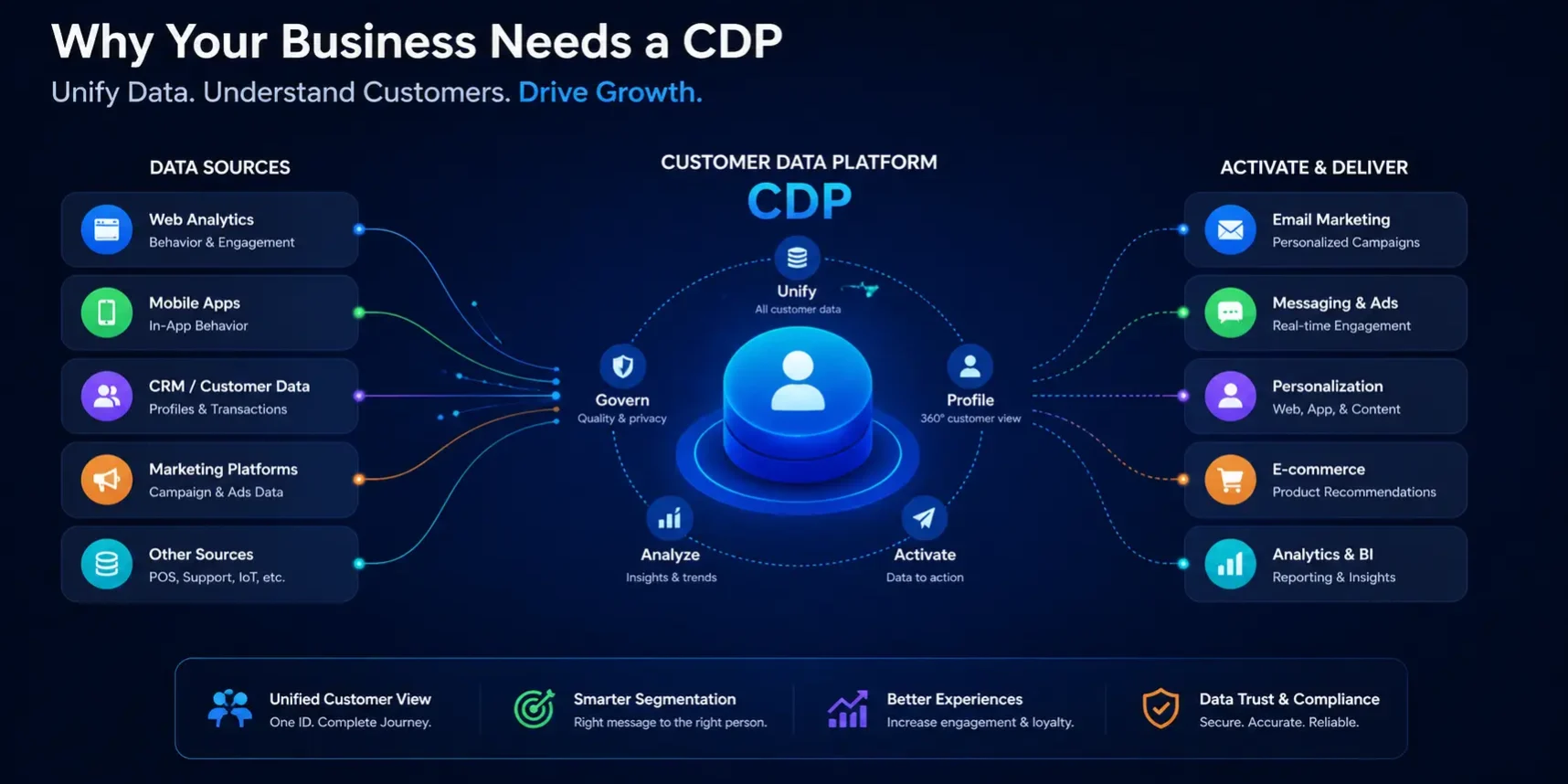
Most organizations operate with disconnected data sources:
- Website analytics tracking user behavior
- CRM systems storing customer profiles
- Marketing platforms capturing campaign engagement
- Mobile apps generating additional interaction data
These systems often work in isolation, resulting in fragmented data that is difficult to combine, analyze, or activate. As a result:
- Customer journeys remain incomplete
- Personalization is limited or inconsistent
- Marketing decisions rely on partial insights
Without integration, data becomes noise instead of value.
What Is a CDP and Why It Matters
A Customer Data Platform (CDP) is designed to unify data from multiple sources into a single, consistent customer profile. It connects behavioral data, transactional data, and engagement data — creating a complete and accessible view of each customer.
More importantly, a CDP enables businesses to:
- Standardize and structure customer data
- Maintain data consistency across systems
- Enable real-time or near real-time data flow
- Activate data across marketing and engagement platforms
It turns disconnected data into a foundation for smarter decisions.
From Data Collection to Data Activation
Traditional analytics focuses on understanding what happened. A CDP extends this by enabling businesses to act on data in real time.
With a properly implemented CDP:
- Customer segments can be dynamically updated
- Personalized messaging can be triggered across channels
- Campaigns can respond to actual user behavior
- Data can flow seamlessly between systems
This shift from passive analysis to active engagement is critical in a competitive digital environment.
Improving Data Accuracy and Trust
One of the most overlooked benefits of a CDP is improved data quality and governance. When data is centralized and standardized:
- Tracking inconsistencies are reduced
- Duplicate or conflicting records can be managed
- Data definitions become aligned across teams
- Reporting becomes more reliable
Trusted data leads to confident decision-making — something many organizations lack when systems operate independently.
Enabling Scalable Marketing and Personalization
As businesses grow, so does the complexity of their data ecosystem. Without a scalable foundation, personalization efforts become difficult to manage and maintain.
A CDP allows organizations to:
- Scale personalization across multiple channels
- Maintain consistency in messaging and targeting
- Adapt quickly to new tools and platforms
- Support both marketing and product use cases
It ensures that growth does not come at the cost of clarity or control.
CDP as a Core Part of Digital Strategy
In 2026, a CDP is no longer a “nice-to-have” tool — it is a core component of a modern digital strategy. It connects data, analytics, and engagement into a unified system that supports both insight and execution.
At Zenitrix Core, we help organizations design and implement CDP strategies that align with their data architecture, analytics goals, and business objectives. From data collection and structuring to activation and reporting, we ensure your customer data works as a strategic asset — not just a technical output.
Turning Customer Data Into Business Value
A CDP is not just about managing data. It is about enabling better decisions, stronger customer relationships, and measurable business outcomes.
Because when customer data is unified, trusted, and actionable — every interaction becomes an opportunity.