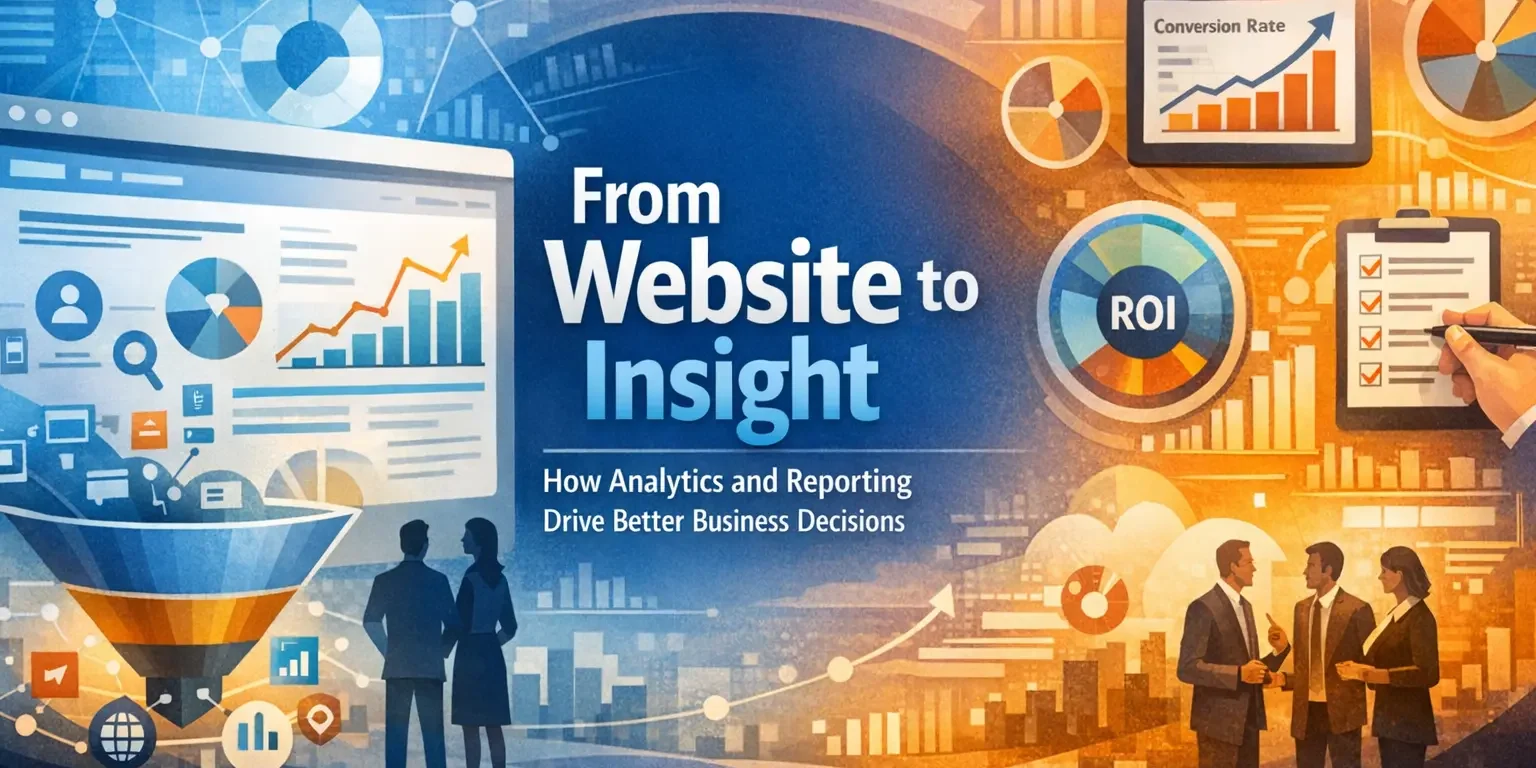
In today’s digital landscape, a website is no longer just a marketing asset — it is one of the most valuable sources of business data. Every visit, click, scroll, and interaction tells a story about user intent, behavior, and expectations. However, without proper analytics and reporting, this data remains fragmented, underutilized, or worse, misleading.
Analytics is the bridge that transforms a website from a static presence into a decision-making engine.

The Role of Analytics Beyond Pageviews
Many organizations still measure website performance using surface-level metrics such as pageviews, sessions, or bounce rate. While these numbers provide a general overview, they rarely explain why users behave the way they do or how digital performance impacts business outcomes.
Modern analytics focuses on behavior, context, and outcomes:
- How users move across pages and features
- Where friction or drop-offs occur
- Which content drives engagement or conversion
- How different channels contribute to user journeys
By structuring analytics correctly, businesses gain clarity instead of noise.
Turning Raw Data into Actionable Insights
Collecting data is only the first step. The real value lies in transforming raw events into insights that support strategic decisions. This is where analytics engineering and reporting play a critical role.
A well-designed analytics framework ensures:
- Accurate and consistent data collection
- Clear event definitions aligned with business goals
- Scalable tracking that grows with the website
- Reliable data sources for reporting and analysis
Once data integrity is established, reporting can shift from manual number tracking to insight-driven storytelling — highlighting trends, opportunities, and risks that matter to stakeholders.
Reporting That Supports Real Decisions
Effective reporting is not about dashboards filled with charts. It is about delivering the right information to the right people at the right time.
Insightful reports help teams:
- Evaluate digital performance objectively
- Identify optimization opportunities
- Measure the impact of campaigns and content
- Align marketing, product, and technology teams around shared metrics
When analytics and reporting work together, decisions are no longer driven by assumptions — they are driven by evidence.
From Insight to Continuous Optimization
Analytics is not a one-time setup. As websites evolve, user behavior changes, and business priorities shift, measurement strategies must adapt accordingly.
Continuous optimization relies on:
- Regular review of data quality and relevance
- Iterative improvement of tracking and reporting
- Ongoing alignment between data, technology, and business objectives
Organizations that treat analytics as a long-term capability — not just a tool — gain a sustainable competitive advantage.
Making Analytics the Core of Digital Strategy
At Zenitrix Core, we believe analytics should sit at the core of every digital strategy. When website data is trusted, structured, and actionable, it empowers teams to make better decisions, improve digital experiences, and drive measurable growth.
From website to insight, analytics and reporting are what turn digital activity into business value.